A shape slips over the hedge and is gone before you have raised your binoculars. Owl, hawk or falcon? Most beginners lose the moment because they are hunting for colour, and colour is the least useful thing in a three-second view. What you can actually catch is outline, head shape, the rhythm of the wings, and the time of day. Get those four things in the right order and identification becomes a process instead of a guess.
This guide covers the groups you are most likely to meet in Britain: the owls, the hawk-like birds such as sparrowhawk, goshawk, buzzard and red kite, and the falcons, from the hovering kestrel to the peregrine. None of it requires expensive kit. It requires a little patience and a habit of watching the bird, not just naming it.
Start with the outline, not the colour
Wings do most of the talking. Before you worry about whether a bird is brown or grey, decide what the wings are doing and how long the tail looks in relation to the body.
- Owls — broad, rounded wings with splayed, fingered tips. The flight looks deep and unhurried, almost moth-like, and the tail is short. A barn owl crossing a field can look like a white blanket being shaken out.
- Hawks — short, rounded wings paired with a noticeably long tail. In a sparrowhawk the tail extends well beyond the folded wingtips when perched, and the silhouette in flight is a cross: brief flurries of flaps, then a glide.
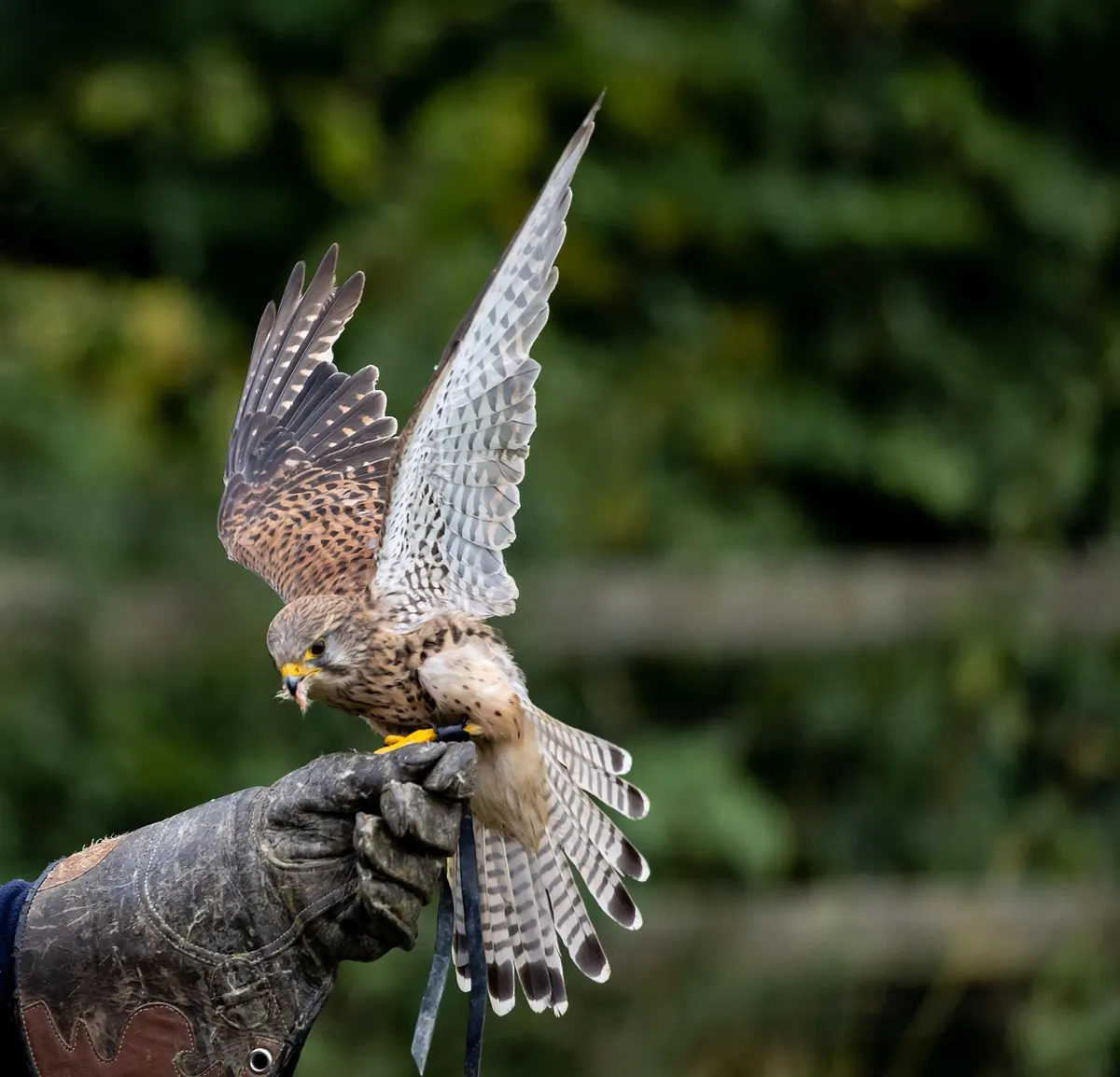
- Falcons — long, narrow, pointed wings swept back like a paper dart. The tail is usually shorter than the wings, except in the kestrel, which has a long tail and uses it as a brake while hovering.
- Buzzards and kites — broad wings and a short tail, often seen soaring. The red kite adds a forked tail, which no other British raptor has.
If you only learn one habit, make it this: glance at the tail before the bird disappears. A long tail with stubby wings says hawk. A short tail with wide wings says owl or buzzard. A short tail with pointed wings says falcon.
Read the head
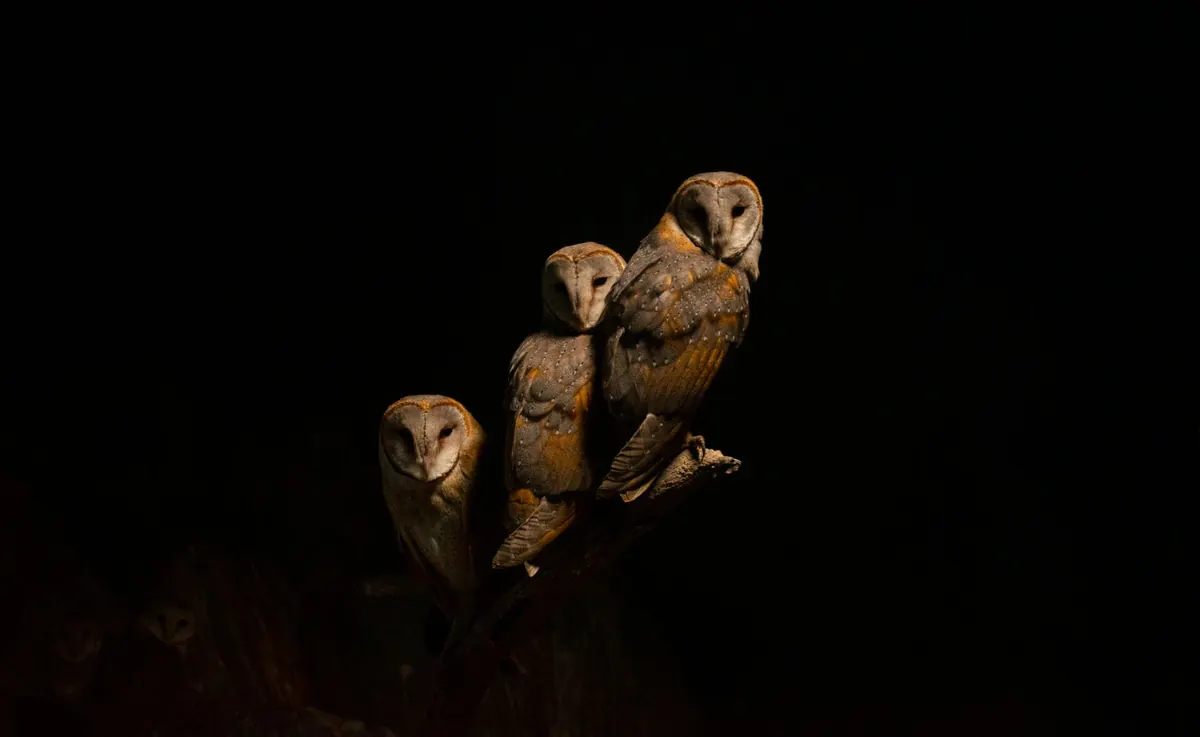
Head shape is the second clue, and it is surprisingly reliable even in poor light. Owls have large, rounded heads with a flat facial disc, and no visible neck — the head appears to sit directly on the shoulders. The barn owl's heart-shaped face is unmistakable; the tawny owl's is a broad, round disc with dark eyes set close together. The "ears" on a long-eared owl are just tufts of feathers and have nothing to do with hearing.
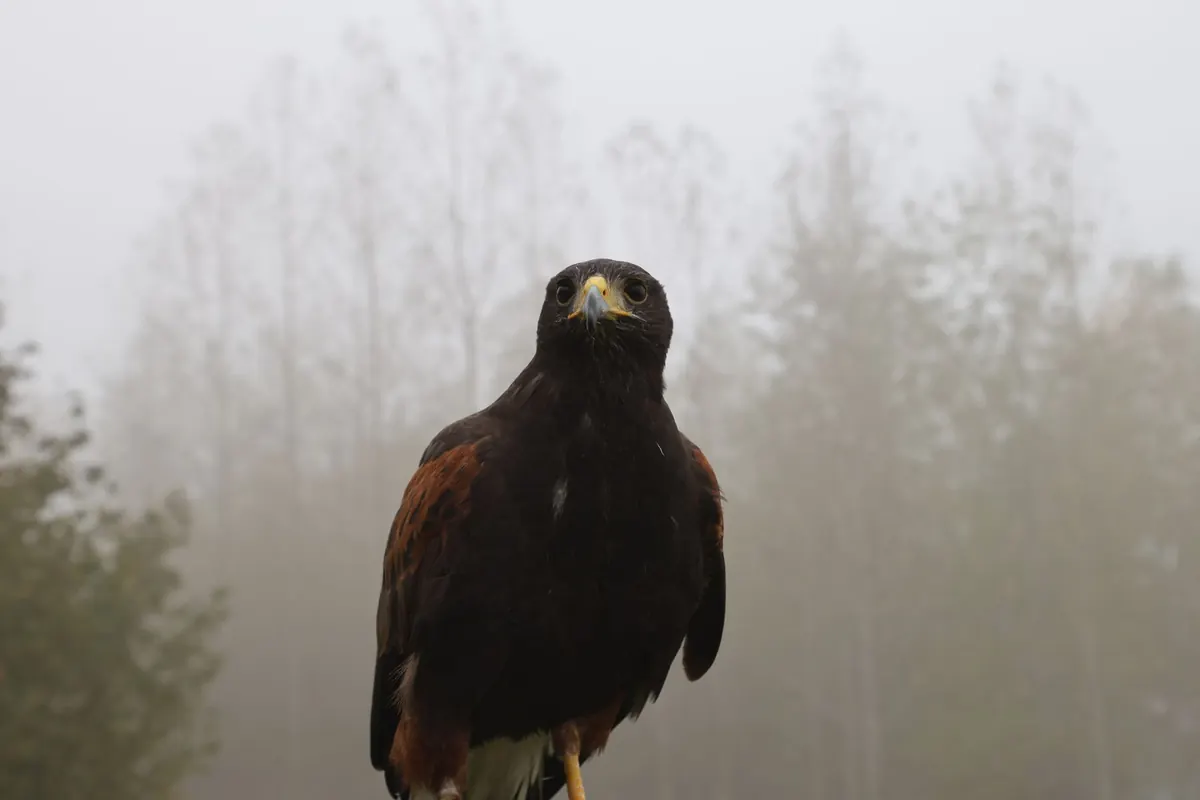
Falcons have small, sleek heads with a dark eye, a short hooked beak and, in peregrine and hobby, a dark moustache stripe running down the cheek. Hawks sit somewhere between: a rounded head, a flat forehead on the sparrowhawk, and an eye that shifts from yellow in adults towards orange-red in the larger goshawk. Head-on, a sparrowhawk looks compact and front-heavy, while a kestrel looks slim and neat.
Watch how they fly
Owls
Owls fly quietly, low and deliberately. Their wingbeats are deep, they glide only briefly, and they often quarter a field or a hedgerow as though following a line. The short-eared owl is the day-flyer: a buoyant, bouncy, moth-like flap-and-glide over moorland, marsh and coastal rough grass, with pale wings and black tips.
Hawks and buzzards
The sparrowhawk's signature is a low, fast dash along a hedge, then a hard turn. It attacks from cover, so you usually see it after the fact, when the flock of starlings has exploded. Buzzards do the opposite: they soar in a shallow V on broad wings, drifting for long stretches with barely a flap, and call with a mewing pee-yaah that people often mistake for a bird of prey being mobbed. Red kites hang and twist on angled wings, buoyant rather than powerful.
Falcons
Falcons fly with stiff, shallow, rapid wingbeats followed by long glides. The kestrel is the one you will see most often, holding station into the wind with its head locked in place as if on a string, then dropping into the grass. A peregrine going somewhere is level and fast, wings beating in a steady, mechanical way; a peregrine hunting is a stoop, wings half-closed, all speed and no ceremony.
Match the bird to the time and place
Context narrows the options before you even see the bird properly. Run through this list the next time you are out:
- Dusk, low over rough grass or a field margin, pale and silent — barn owl.
- Night, woodland edge, the classic quavering hoo-hoo and a sharp ke-wick — tawny owl.
- Bright winter afternoon, quartering low over marsh or moor, bouncy flight — short-eared owl.
- Garden or woodland edge, sudden rush and a scatter of small birds — sparrowhawk.
- Motorway verge, hovering over a grass strip, then dropping — kestrel.
- Open country, a bird perched on a fence post for long periods, soaring between — buzzard.
- City centre, a pair high on a tower or cathedral, fast level flight — peregrine.
Where beginners trip up
Buzzard or owl?
A soaring buzzard has broad wings and a rounded head, so a low-flying one seen against a hedge can read as a huge owl. The giveaway is the time of day and the flight itself: buzzards soar and mew in daylight, while owls do neither. If it is holding a thermal at noon, it is not an owl.
Kestrel or sparrowhawk?
Both are small, and both hover occasionally. The kestrel hovers often and well, with pointed wings and a fanned tail; the sparrowhawk hovers rarely, briefly and awkwardly, and is far more likely to be seen in a low, level dash. Pointed wings with a hover means kestrel. Rounded wings with a long tail and a scatter of birds means sparrowhawk.
Barn owl or short-eared owl?
Barn owl: white underneath, heart-shaped face, silent, crepuscular. Short-eared owl: yellow eyes in a black-masked face, browner all over, often flying in daylight, and with a flight that rises and dips rather than gliding smoothly.
Quiet, low and unhurried: think owl. Fast, low and sudden: think hawk. High, level and quick-winged: think falcon.
Build the skill slowly
Pick one field, one reservoir or one stretch of footpath and visit it at roughly the same times each week. Familiarity does more for identification than any book. Watch for shapes against the sky, get a pair of 8x42 binoculars if you can, and count wingbeats for ten seconds — the tempo alone often separates a kestrel from a sparrowhawk.
Write down what you saw, where and when, even in rough notes. After a month you will have your own local pattern of who hunts at what hour, and the three-second view will start to feel generous rather than cruel. Keep your distance from nests and roosts, and stay on paths — wild birds, their nests and their eggs are protected in the UK, and owls in particular are easily disturbed, especially in spring. If you suspect a nest, watch from far enough away that the birds carry on as though you were not there. That is the surest sign you are getting close to understanding them.